How do you use digital out-of-home advertising?

You use digital out-of-home advertising by making smart choices about screens, goals, timing and buying: from one metro station to a full station domination
October 15, 2026
Op deze pagina
In het kort
You use digital out-of-home advertising by first defining your goal and then choosing the screens, moments and content that fit it. You buy directly or programmatically and tailor your message by location and time of day. This makes out-of-home just as targeted as online, but in the real world.

Digital out-of-home advertising, also known as DOOH, is advertising on screens in public spaces. This page focuses on the practical side: which formats there are, what you use it for, how to buy it and how to get the most out of it.

‍

What types of digital-out-of-home advertising are there?

‍

Digital out-of-home advertising can be found wherever lots of people pass by. The best-known formats:

‍

  • Digital billboards along motorways and arterial roads.
  • Digital advertising columns and screens in shopping streets and at stops.
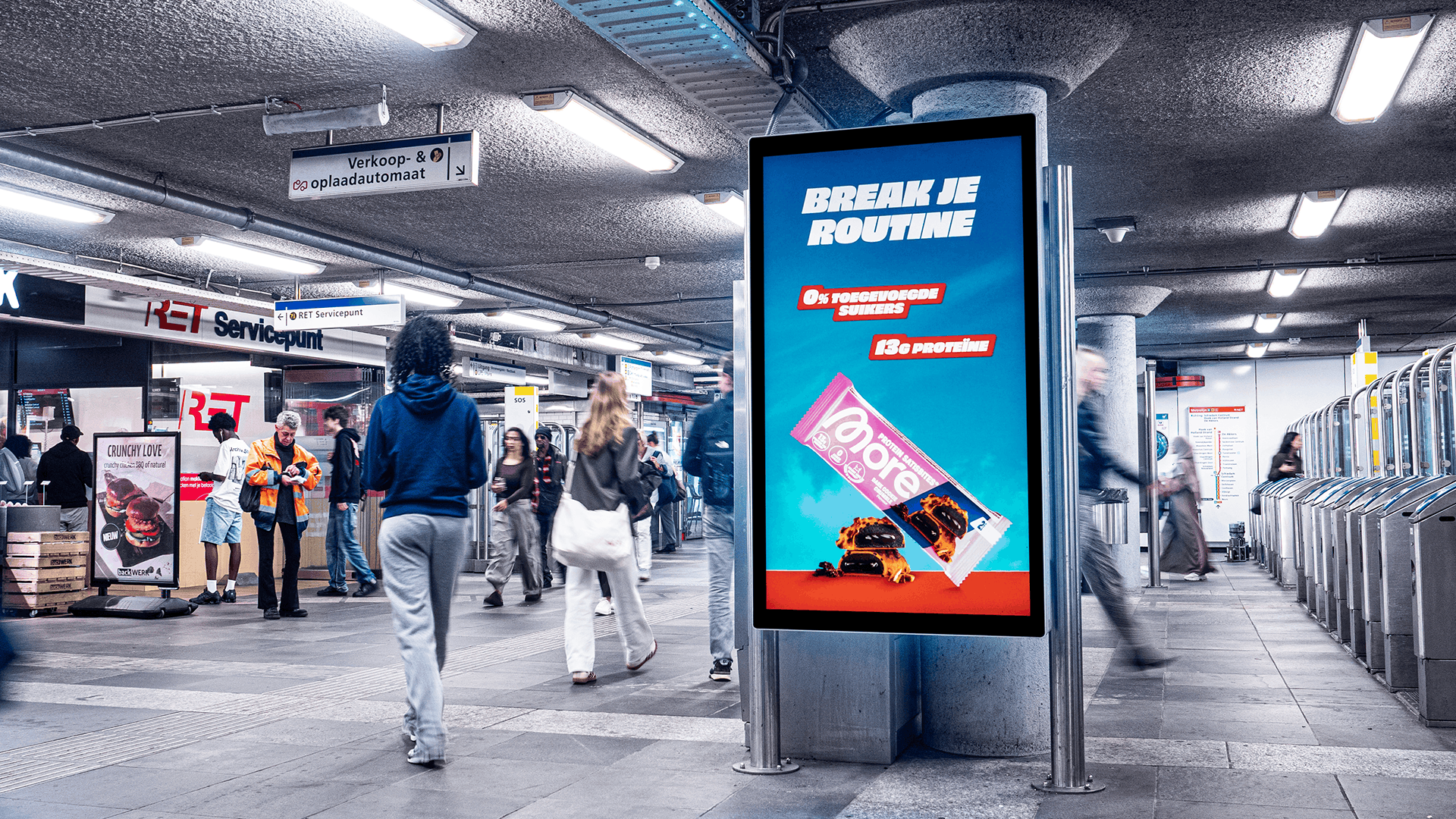
  • Screens in public transport, such as on metro platforms and in station halls.
  • Large LED screens on buildings and squares.
  • Giant formats: large screens combined with printed vinyl wrapping around them.

‍

What do you use digital out-of-home advertising for?

‍

Digital out-of-home advertising is more than a brand campaign. You can use it for every step of the customer journey:

‍

  • Awareness: making your brand visible to a large audience in a short time.
  • Activatie: getting people to act straight away, for example via a QR code leading to a promotion or test drive.
  • Impact: taking over a location with a campaign that people photograph and share.
  • Interactief: letting travellers take part, for example by using their phone as a controller.

‍

You’ll find examples in our cases.

‍

How do you buy digital out-of-home advertising?

‍

You can buy digital out-of-home advertising in two ways:

‍

  • Direct: you agree on screens, period and frequency with the media owner. This suits campaigns with a fixed plan or a special execution, such as a giant format.
  • Programmatic: you buy automatically through your own buying platform (DSP), based on audience, time and bid. This suits you if you want to switch flexibly or combine DOOH with your online buying.

‍

Programmatic isn’t necessarily more expensive. You pay per thousand impressions, the CPM, and only buy at the moments and locations that matter to you. CSDM was the first publisher to connect its screens to MyAdbooker, one of the first programmatic platforms for DOOH.

‍

How do you target with digital out-of-home advertising?

‍

With digital out-of-home advertising, you target by location, time and context. In the metro, you choose per station, so you can be very local. You can run your ad only during the morning rush hour, on Friday evenings or around an event. And you can tie in with the weather, a match result or another live data source.

‍

We measure how many people you reach per station, using our own research on the platforms and passenger data from GVB and RET.

‍

How do you create good content for digital screens?

‍

You create good content for digital screens for the location, not for another channel. A TV commercial or social video rarely works one-to-one. Keep these points in mind:

‍

  • Work without sound. The visuals have to tell the story on their own.
  • Keep it short and clear: one message, a large logo, little text.
  • Use motion, but make sure a still moment can also be understood.
  • Check the format for each screen. Not every screen has the same aspect ratio, so one video won’t automatically scale well everywhere.
  • Deliver on time according to the specifications, especially for dynamic content with live data.

‍

With giant formats, you design the screen and print as a single unit, so the video can flow seamlessly into the vinyl wrapping around it.

‍

What are the disadvantages of digital out-of-home advertising?

‍

Digital out-of-home advertising also has its limitations. It’s good to know them in advance:

‍

  • You share the screen with other advertisers in a loop. The bigger your share of voice, the more often you’re visible.
  • There’s no sound, so your creative needs to be visually strong.
  • Digital screens are mainly found in cities. In smaller towns, availability is limited.

‍

In the metro, one drawback of street screens doesn’t apply: bright sunlight. Underground, your screen is always clearly visible.

Getting started with digital out-of-home advertising

‍

Want to know how digital out-of-home advertising in the metro fits your goal? Explore the options for advertising in Amsterdam and advertising in Rotterdam, or get in touch with CSDM. We help you think through your goal, your creative and the right way to buy, even if you work through an agency.

Frequently asked questions about digital out-of-home advertising

How much does digital out-of-home advertising cost?

The cost of digital out-of-home advertising depends on the number of screens, the locations, the period and how often your ad runs. With programmatic buying, you pay per thousand impressions. Get in touch for a tailored proposal.

Can I use my TV commercial or social video on a metro screen?

Usually not without adapting it. Metro screens have no sound, and people only look briefly. Create a version that works without sound and has one clear message, and check the screen’s aspect ratio.

Is digital out-of-home advertising only for big brands?

No. Because you can buy per station, time of day and period, digital out-of-home advertising also suits smaller budgets. A local business owner, for example, can choose only the stations around their own business.