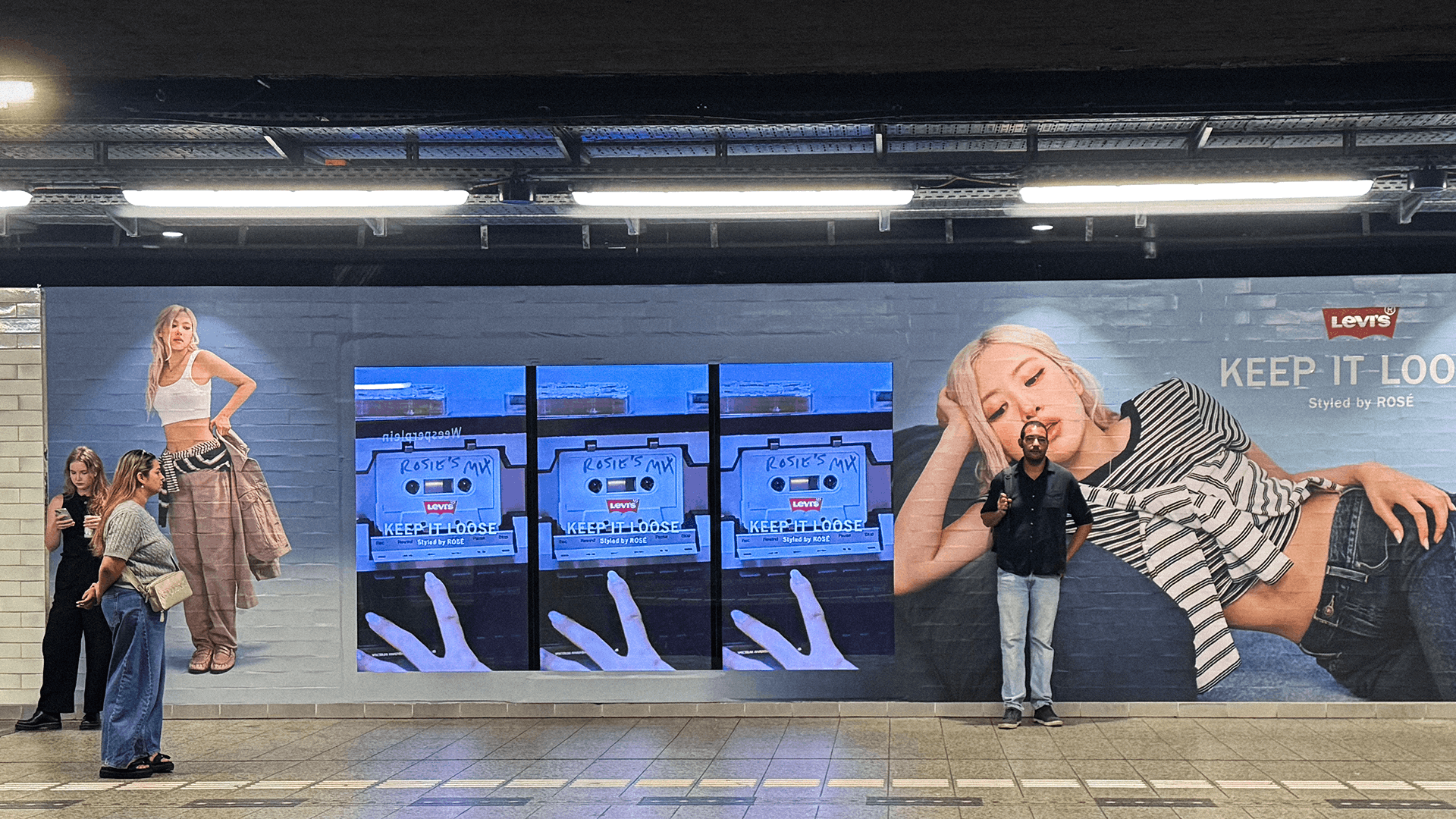
OOH, short for out-of-home, is the umbrella term for all advertising you come across outside your own home. From a poster at the bus stop to a large screen in a station hall: as soon as you step out the door, you’re an audience for OOH.
OOH comes in many forms, which you can roughly divide by location and medium.
Out-of-home advertising reaches people in the physical world, while online advertising reaches people on their own screens. You can see that difference in three ways:
The two complement each other well. OOH makes a brand visible in the city, while online helps people who want to search or buy afterwards.
OOH works with advertising sites owned by media companies, known as media owners. They manage the posters and screens, sell the advertising space and make sure your ad is visible in the right place at the right time. CS Digital Media is one such media owner: we manage the digital advertising screens in the Amsterdam and Rotterdam metro, in partnership with GVB and RET.
You buy space on a media owner’s posters or screens for a set period and at the locations you choose. Digital screens can also be bought automatically, through programmatic DOOH. CSDM offers both: you book directly with us, or programmatically via platforms such as MyAdbooker, to which CSDM was the first publisher to connect its screens.
Out-of-home reach in the Netherlands is measured by NMO Buitenreclame, the market standard that has been part of the Nationaal Media Onderzoek (Dutch National Media Research) since 2026. This research combines the location and visibility of every advertising site with travel data from a national panel. This tells you how many people can see an ad. To find out how to determine the effect of a campaign, read measuring the effect of DOOH.
You design an eye-catching out-of-home campaign with one message, few words and a brand that people recognise at a glance. Eye-tracking research in dentsu's OOH Report 2026 shows that more than half of passers-by actually look at an out-of-home ad. That glance often lasts only one to two seconds, but that is enough to recognise and remember a brand. It only works, however, if the creative is simple, recognisable and distinctive.
A few rules of thumb:
That’s why reach alone says nothing about your creative. In the market, attention is shifting from how many people can see an ad to how many people actually look at it and remember the message. Two campaigns with the same reach can therefore have a very different effect, purely through the strength of the visual.
In the metro, OOH is mainly digital: screens on the platforms and in the station halls. CS Digital Media has more than 500 digital screens in the Amsterdam and Rotterdam metro, across the GVB and RET networks.
The metro is different from places people only pass by. Travellers wait on the platform, often for minutes rather than seconds, so they see your message for longer and have time to respond. You also reach a young, urban audience. To see which screens are at each station, visit the station pages for Amsterdam or Rotterdam.
Want to know what OOH in the metro can do for your brand? Explore CSDM’s OOH advertising options or get in touch with CSDM.
