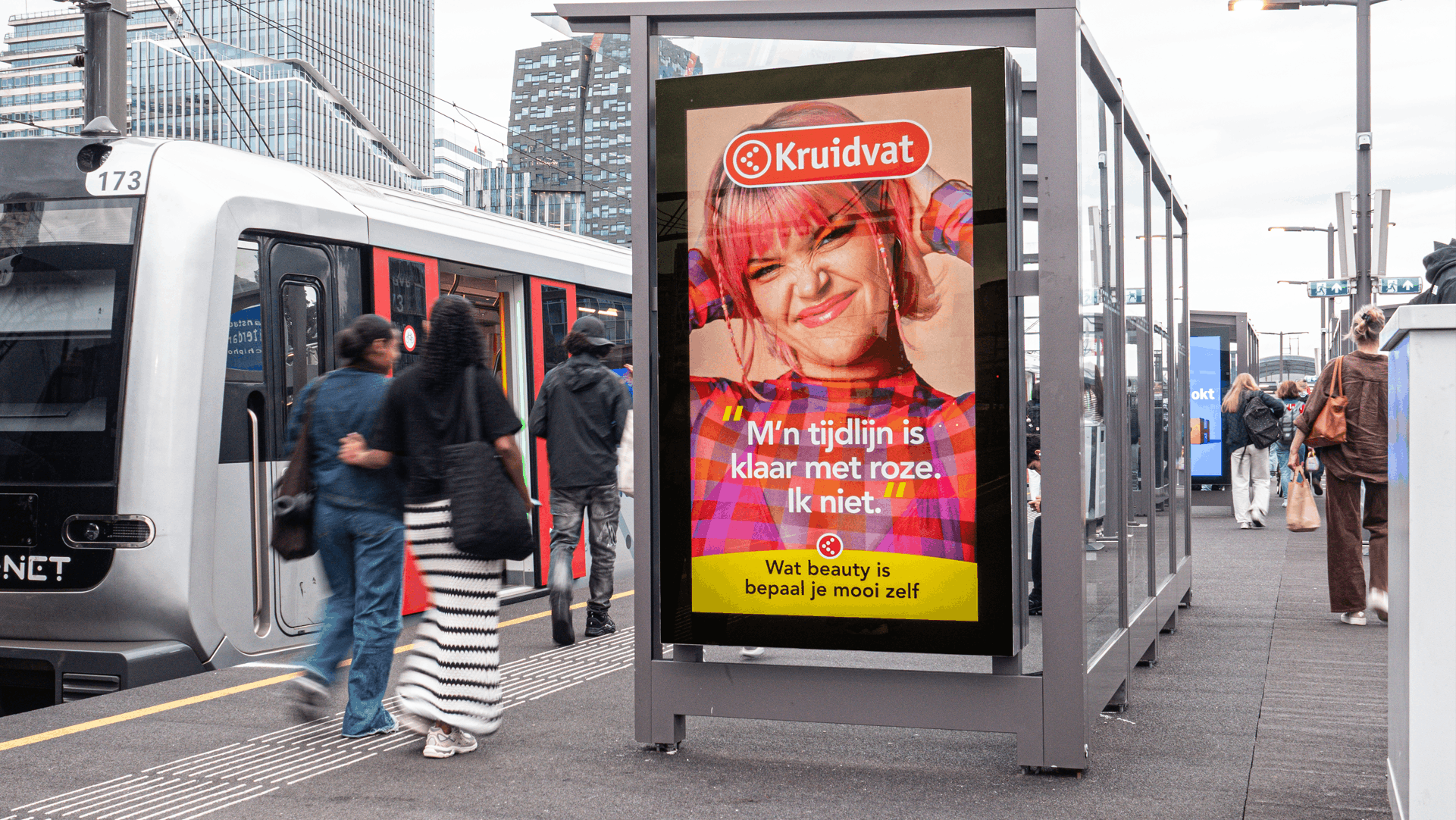
What is DOOH?

DOOH (digital out-of-home) is digital outdoor advertising: ads shown on screens in public spaces, such as at train stations and in the metro.
October 7, 2026
Op deze pagina
In het kort
DOOH is digital outdoor advertising on screens in public spaces, such as on platforms, in station concourses and along busy routes. The abbreviation stands for digital out-of-home. Because the screens are controlled centrally, you can change your message by time of day, by location or by moment, without printing or putting up anything.

DOOH, short for digital out-of-home, is the digital form of outdoor advertising. Instead of running on paper, your ad runs on a screen: along the road, in a shopping centre or on the platform of a metro station. This way, DOOH combines the reach of outdoor advertising with the flexibility of digital media.

‍

What does DOOH mean and what are the benefits for advertisers?

‍

DOOH stands for digital out-of-home: advertising on digital screens that people see when they are out and about. In Dutch, it is called digitale buitenreclame. For advertisers, the value lies mainly in four points:

‍

  • You can adjust your message quickly. A new ad goes live without any printing.
  • You choose the moment. An ad can run only during the morning rush hour, or only at the weekend.
  • You can use motion. Video and animation stand out more than a still image.
  • You reach people outside their own screen time. Outdoor advertising can't be clicked away, skipped or blocked.

‍

DOOH now accounts for the largest share of the Dutch out-of-home advertising market. According to the industry association Outreach, 60 percent of the €171 million in OOH revenue in the first half of 2026 went to digital. Read more about it on this page.

‍

How does DOOH work?

‍

DOOH works through networks of digital screens that a media company controls centrally. Each screen plays a fixed sequence of ads one after the other, known as the loop. You buy a slot in that loop, for a set period and on the screens you choose.

‍
There are two ways to buy DOOH:

‍

  • Direct: you agree on locations, campaign duration and frequency in advance with the screen operator.
  • Programmatic: you buy automatically through a buying platform, based on target audience, budget and bid.

‍

Because the screens are digital, an ad can respond to data such as time of day, weather or a live event. The same campaign can then show something different in the morning than in the evening.

‍

What is the difference between DOOH and traditional outdoor advertising?

‍

The difference between DOOH and traditional outdoor advertising lies in the medium: DOOH uses digital screens, while traditional outdoor advertising uses printed posters and billboards.

‍

The other differences follow from that:

‍

  • Visuals: a poster shows a single still image. A screen shows several ads one after the other in a loop, either static or moving.
  • Updating: a new poster has to be printed and put up. A DOOH ad can be changed centrally and quickly, without any printing.
  • Timing: a poster stays in the same place for a fixed period. A DOOH ad can be scheduled by time of day, by day or by moment.
  • Buying: traditional outdoor advertising is bought directly from the media owner. DOOH can be bought directly or programmatically.

‍

Both formats fall under outdoor advertising and are often used together. Their reach is also measured in the same way: in the Netherlands through NMO Buitenreclame, the market standard that has been part of the Nationaal Media Onderzoek (National Media Survey) since 2026.

‍

What does DOOH in the metro involve?

‍

In the metro, you see DOOH on screens on the platforms and in the station concourses. CS Digital Media operates the digital advertising screens in the metro networks of GVB in Amsterdam and RET in Rotterdam.

The platform is one of the few places in the city where people willingly stand still. Passengers wait for their metro, look up from their phones and notice what is happening around them. A short message with a clear visual and few words works best there.

‍

DOOH in the metro can also be bought programmatically. CSDM was the first publisher to connect its screens to MyAdbooker, one of the first programmatic platforms for DOOH, founded in Amsterdam in 2012. To see which screens are at each station, visit the metro station pages for Amsterdam and Rotterdam.

‍

Get started with DOOH

‍

Want to know what DOOH in the metro can do for your brand? Explore the options for advertising with DOOH in the metro or get in touch with CSDM. We're happy to help you think through locations, timing and creative.

Frequently asked questions about DOOH

What are the benefits of DOOH compared to traditional advertising?

DOOH is more flexible than traditional advertising: you can change your message without printing, choose when your ad runs by time of day and location, and use moving images. Like other outdoor advertising, DOOH can't be clicked away or skipped.

How can I promote my business on DOOH screens?

To promote your business on DOOH screens, contact a media owner or media agency, choose your locations and campaign duration, and supply a short, eye-catching ad. Pick screens in places your target audience passes by, such as stations near your business.

Where are DOOH screens located?

DOOH screens are located in places with high footfall: at train and metro stations, along busy roads, in shopping centres and at airports. In the Amsterdam and Rotterdam metro, you'll find them on the platforms and in the station concourses.

Is DOOH the same as programmatic DOOH?

No. DOOH is the umbrella term for advertising on digital screens outside the home. Programmatic DOOH is a way of buying those screens: automatically through a platform, based on target audience, budget and bid, rather than through a fixed agreement made in advance.