
Ik schrijf even een USP zinnetje om te kijken hoe dit staat
Ik schrijf even een USP zinnetje om te kijken hoe dit staat
zinnetje om te kijken hoe dit staat


OOH is growing. But are we growing in the right direction?
Does buying more efficiently also mean advertising more effectively? Nathan van Gisbergen on the real impact and future of the OOH industry.
OOH competition: Looking inward or looking outward?
As Sales Director at CS Digital Media, I deal with reach, rates, campaigns, innovation and, of course, the competition every day. It comes with the territory. We develop new buying models, optimise our inventory and are constantly looking for ways to serve advertisers better.
But precisely because I'm in the thick of it every day, I find myself wondering about something more and more often.
"Aren't we, as an OOH industry, mostly just very busy with each other?"
Sustainability
With smart energy solutions and green ambitions, together we're building a responsible, clean future.
Innovation
Through continuous technological innovation, we create the smart, impactful media experiences of the future.
Health
Through meaningful initiatives and targeted actions, we promote the health and vitality of people and society.
Experience
We transform public spaces into inspiring, dynamic environments that move and connect us.

Is OOH growing through volume or through value?
We debate CPMs, discount structures, programmatic and new technologies. We try to set ourselves apart from other media owners and keep optimising our commercial models.
Meanwhile, the Dutch OOH grew by no less than 20% in the first half of 2026. A great development, and one we can be proud of as an industry.
But revenue growth doesn't automatically mean our medium is taking on a bigger role in the overall media mix. After all, part of that growth may also come from expanding our networks, adding more digital screens and further commercialising existing locations.
There's nothing wrong with that in itself. But it does raise a more important question for me:
"Are we mainly growing by taking market share from each other and adding more and more screens, or are we actually succeeding in attracting new advertisers and media budgets to OOH?"
Because perhaps our biggest growth opportunity doesn't lie with the competitor across the street, but with the brands that have yet to fully discover what visibility in the physical world can mean for them.
A brand shouldn't only be something you come across online
We live in a time when brands have more and more ways to reach their audience digitally. Campaigns can be tailored down to the individual, results are visible almost instantly and every interaction can be measured.
That's valuable. But at the same time, I think we sometimes forget how important it is for a brand to be present beyond the screen in someone's hand.
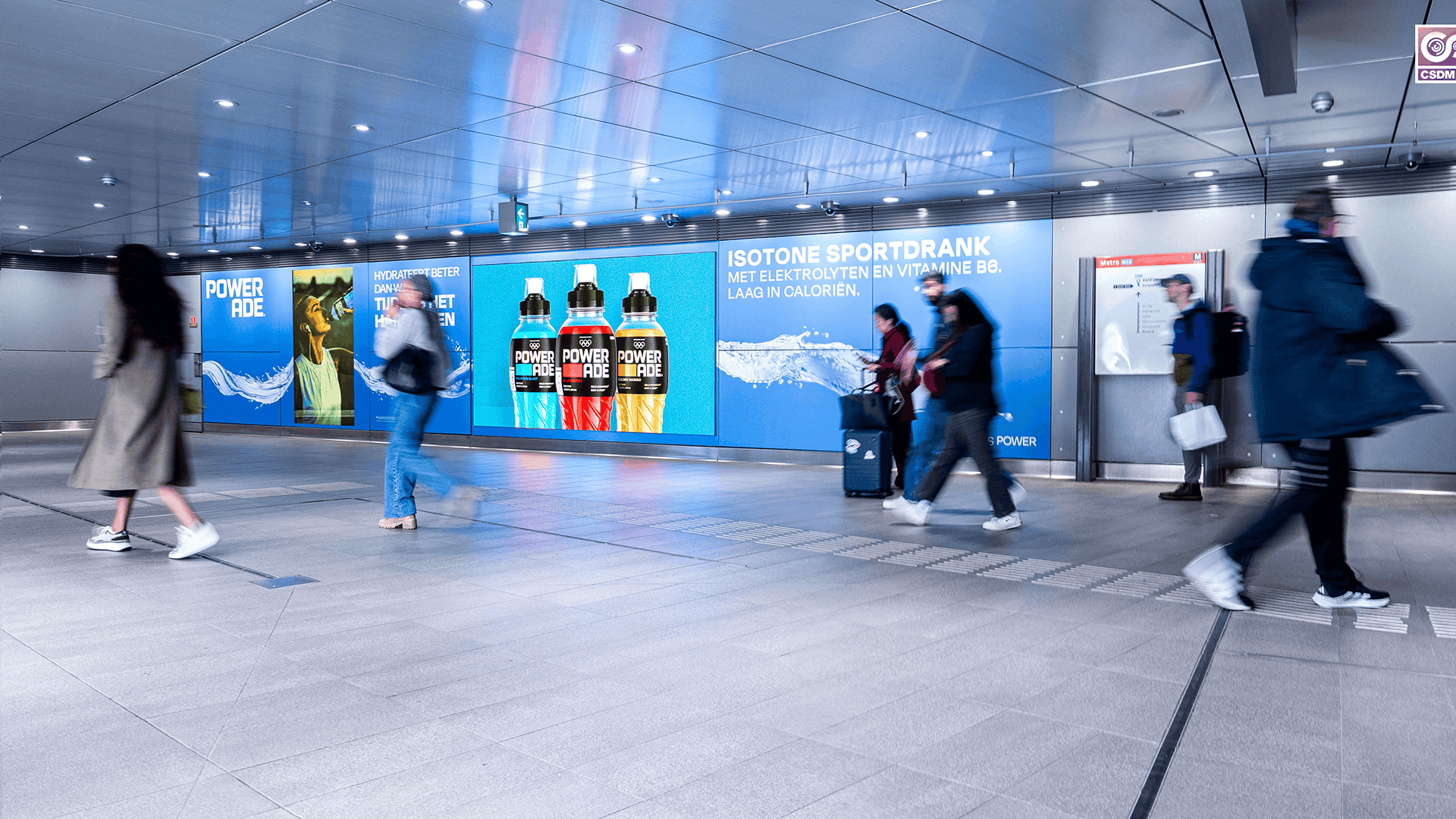
A brand you come across on your way to work. At the station, along the road or in the middle of the city. Not because you searched for it or fall within a certain audience segment, but because it's part of the environment you move through every day.
That visibility does something for brand recognition. Especially when you encounter it at several different moments.
And that's exactly where OOH can play a distinctive role. Not just by delivering reach, but by literally giving brands a place in consumers' everyday lives.
We don't just sell reach. We give brands the opportunity to be visible in people's daily lives.
For established brands, that can help strengthen their position. For new brands, it can be an important step in building awareness and claiming a place in the consumer's mind.
Because no matter how active a brand is online, ultimately you want people to recognise it, remember it and think of it at the right moment.
Innovation should strengthen the power of OOH
Our industry, too, is seeing technological developments follow one another at a rapid pace. Digitalisation, programmatic and new buying models are making OOH increasingly flexible and accessible.
At CS Digital Media, for example, we introduced Floating CPM together with MyAdBooker. With it, we're exploring how to make more efficient use of available digital capacity and give advertisers more flexibility.
An interesting development, but in my view we need to make sure innovation doesn't become purely a discussion about price.
Because buying more efficiently isn't automatically the same as advertising more effectively.
A low CPM on its own says little about the impact of a campaign. The right location, sufficient visibility, contact frequency, context and, above all, strong creative are at least as important.
And not every contact is the same. Someone who briefly walks past a screen is in a very different situation from someone waiting several minutes on a metro platform. The environment, the moment and the time someone has to take in a message all help determine how much attention a campaign can get.
That's why I believe we as an industry should talk not only about how many people we reach, but also about the attention our campaigns actually manage to capture.
At CS Digital Media, we therefore believe the future of OOH lies not just in expanding our reach, but above all in better understanding the value of that reach. What chance does someone actually have of seeing a campaign? What role do location, dwell time and environment play? And how can we use those insights to make campaigns more relevant and effective?
That's also the direction we're developing in. By combining traveller data, insights into opportunities to see and new measurement methods in increasingly smart ways, we want to look beyond the traditional reach model. Not simply to sell more impressions, but to better understand which visibility actually adds value.
Technology should help us better understand and increase that attention and impact, not reduce the value of our medium to the price of a thousand contacts.
The power of the streetscape
What I personally find so interesting about OOH is that the medium can go far beyond simply showing an ad.
A strong campaign can become part of the streetscape, spark conversations and even take on a life of its own beyond the original media placement.
Take our adidas Superstar campaign with Roxy Dekker. Showcasing her in large format in our metro stations created more than just physical visibility. Roxy visited the locations herself, created content around her own campaign and then shared it on her social channels.
That's a great example of how different media can reinforce each other. The physical campaign became a springboard for online content and additional attention.
And I think there's an important lesson in that.
OOH and online don't have to compete for attention. In fact, they can help each other earn it.
A strong presence in the streetscape can build recognition that is then amplified online. Conversely, a brand people know digitally can feel bigger and more tangible precisely because of a physical campaign.
The challenge for 2027
I believe OOH still has a lot of growth potential. Not only among large, established advertisers, but especially among ambitious challengers and brands that barely use the medium today.
But if we want to tap into that potential, we shouldn't only look at our own inventory, rates and technological capabilities.
In my view, we as an industry could also take a more critical look at ourselves. We're good at calculating how many people we can reach, but do we understand well enough how much attention our campaigns actually get and what that visibility delivers for a brand?
Because ultimately, an advertiser doesn't care about the number of contacts in itself. What matters is how those contacts contribute to brand awareness, brand preference and, ultimately, the results of a campaign.
That's where I think an important challenge still lies for our industry. Not just continuing to invest in new technology and more screens, but also in research that makes the real impact of OOH visible.
That calls for more collaboration between media owners, media agencies, technology partners and advertisers. Not only to buy our medium more smartly, but above all to better understand and demonstrate what it can mean for brands.
And as an industry, we also have a responsibility. Public space belongs to everyone. That means we have to stay critical of the amount of advertising, the quality of our executions and the way brands show up in the streetscape.
More screens and more ads aren't necessarily better.
Ultimately, it's about how we give brands a meaningful place in people's everyday lives, without becoming an irritation.
And if we succeed in that, we won't just create more value for advertisers and consumers, we'll also be building a stronger future for OOH together.
Nathan van Gisbergen
Sales Director


Vergelijkbare Artikelen
asdfasdfasdf
Lorem ipsum dolor sit amet, consectetur adipiscing elit. Suspendisse varius enim in eros elementum tristique. Duis cursus, mi quis viverra ornare, eros dolor interdum nulla, ut commodo diam libero vitae erat. Aenean faucibus nibh et justo cursus id rutrum lorem imperdiet. Nunc ut sem vitae risus tristique posuere.
Case bekijken


