
Ik schrijf even een USP zinnetje om te kijken hoe dit staat
Ik schrijf even een USP zinnetje om te kijken hoe dit staat
zinnetje om te kijken hoe dit staat


Late Rembrandt: CS Digital Media's DOOH campaign for the Rijksmuseum
Discover how CS Digital Media used DOOH, programmatic marketing and interactive apps to make the Late Rembrandt exhibition accessible to the whole of the Netherlands.
The Late Rembrandt exhibition at the Rijksmuseum is regarded as the cultural highlight of 2015. More than a hundred works from (private) collections around the world were brought together for a one-off show. Just as unique was the 'digital case' rolled out around the exhibition, in which CS Digital Media played a key role. So what made this DOOH campaign so special and distinctive? A reconstruction in five acts: concept, media mix, creative, production and results.
Sustainability
With smart energy solutions and green ambitions, together we're building a responsible, clean future.
Innovation
Through continuous technological innovation, we create the smart, impactful media experiences of the future.
Health
Through meaningful initiatives and targeted actions, we promote the health and vitality of people and society.
Experience
We transform public spaces into inspiring, dynamic environments that move and connect us.
Concept: Rembrandt for everyone
The Rembrandt case for the Rijksmuseum and KPN was supported by various media companies, from online to offline, from The Online Company to CS Digital Media. All their concept executions served the overarching goal: making Rembrandt accessible to the whole of the Netherlands.
At the end of 2014 and the start of 2015, things were remarkably quiet at the Rijksmuseum. But behind the scenes, people were hard at work, and not only on a traditional museum display of the paintings, drawings and prints the master made between roughly 1652 and 1669. 'Late Rembrandt' had several 'layers', goals and starting points, involving multiple parties.
First, the Rijks itself and main sponsor KPN. But agencies such as Mindshare and Kinetic (for campaign planning in traditional media: TV, radio and print), The Online Company and, last but not least, MyAdbooker and CS Digital Media were also involved. These parties were responsible for developing a 'smart mix' of innovative digital technology (offline and online) with state-of-the-art creative and programmatic marketing (activation towards virtual tours on CS Digital Media's screens). The result was, on the one hand, the ultimate illustration of how a successful video campaign can and should be set up and, on the other, a demonstration of how different disciplines (creative, sales, marketing, traffic) come together, complement and strengthen each other.
'The overarching goal of the campaign was to help KPN, as main sponsor of the Rijksmuseum, make the Late Rembrandt exhibition accessible to everyone,' says CS Digital Media CEO Radjen van Wilsem. 'To achieve that, CSDM used its public transport networks at metro stations in Amsterdam and Rotterdam. On the one hand, we wanted to emphasise awareness with a digital art gallery. On the other, we developed an etching app that added an interactive element to the campaign.
'And just as importantly, both concepts could be translated online, as viral content, so that an even larger audience could discover the exhibition. For our company, it was unique that we were able to run this campaign as a full-service operation. That meant we were involved in both the concept and putting together the media mix. And within that media mix, we were also able to apply a new buying method: programmatic buying.'
Media mix: From sponsored stories to interactive tours
The Rembrandt case stood out above all for its versatile, integrated use of different media. The press paid special attention to the campaign's innovative elements, such as the activation via MyAdbooker towards the virtual tours on CSDM's digital screens. But there were other elements worth highlighting too.
The Rembrandt case stood out above all for its versatile, integrated use of different media. The press paid special attention to the campaign's innovative elements, such as the activation via MyAdbooker towards the virtual tours on CS Digital Media's digital screens. But there were other elements worth highlighting too. The campaign slogan, 'There's so much more than The Night Watch', already hinted that there was more behind the 'physical' exhibition. At the heart of it was a dedicated KPN Rembrandt website. To support it, an integrated media approach was chosen, with the main aim of driving traffic. Social content on Facebook and Twitter drew attention to the exhibition and generated clicks to the site. The site then offered a deeper dive into the exhibition, including background information on the works, tours led by Dutch celebrities such as André Kuipers and Sophie Hilbrand, and an X-ray feature that let visitors discover the painting behind the painting with a single click. In Rembrandt's time, canvases were often painted over, partly to save costs.
These and many other online activities (from takeovers and sponsored stories on relevant platforms to interactive virtual tours via a push-up for tablet and smartphone, and online banners) were consistently supported by offline activities, in the sense that every execution related directly to Rembrandt's works. For example, the popular Dutch talk show De Wereld Draait Door (DWDD) featured Late Rembrandt, there were TV and radio spots with the celebrities mentioned earlier, ads in national and regional newspapers and on billboards, and a special episode of RTL Late Night was broadcast from the epicentre of the entire campaign: the Rijksmuseum itself. Right beneath The Night Watch, no less!
Finally, there were Rembrandt canal cruises, Rembrandt walking routes, Rembrandt lectures, Rembrandt workshops and even Rembrandt painting courses. The exhibition sold out at lightning speed, attracting a record 520,698 visitors. But thanks to the online and offline access, no one in the Netherlands had to miss out on Rembrandt during the relatively short run (12 February to 17 May). And, as measurements would later show, nobody did.
'For the first time, a new generation can discover the best work of one of the very greatest painters the Netherlands has ever known,' said then Rijksmuseum director Wim Pijbes. Mark Versteegen, Director of Sponsorship at KPN, agreed, stating that with its knowledge of ICT and digital technologies, KPN had 'brought Late Rembrandt to life even more. The whole of the Netherlands can enjoy Rembrandt's art. In this way, as a sponsor, we're truly adding something to the experience of this remarkable exhibition.' Versteegen stresses that sponsorship isn't just about financial support; it's above all knowledge and technology that support the museum's ambitions. 'For example, museum guides use iPads on their tours, and visitors find iPads at parts of the collection that give them additional information about the artworks. The Rijksmuseum's much-praised website is also hosted by KPN (…) Less visible, but just as important, is a wide range of innovative products KPN provides in telephony, data traffic and data storage. With these, we help the Rijksmuseum realise its strategy of being an innovative, state-of-the-art cultural institution for the world.'
The trade press, however critical it often is (and rightly so), fully agreed. On 20 March 2015, John Goedegebuure wrote on the Marketingfacts website: 'KPN, as main sponsor of the Rijksmuseum and the Late Rembrandt exhibition, proves with a wide variety of executions that corporate sponsorship can be more than bluntly promoting the sponsor's products. It makes this unique, one-off exhibition accessible to the entire Dutch population, while subtly showing the rest of the world the "masterly" possibilities our "fantastic country" (loosely quoting Prime Minister Rutte) has to offer.' The press regularly cited the activation via MyAdbooker towards the virtual tours on CSDM's screens, and the animated works created in the CSDM studio, as innovative elements.

Creative: Animations bring Rembrandt to life
The CS Digital Media studio 'unlocked' 12 Rembrandt masterpieces for 70 digital shelter screens in Rotterdam and Amsterdam, using subtle animations. How did they go about it? And what were their guiding principles?
An almost serene atmosphere filled the CS Digital Media creative studio as work began on an exceptional tour de force. True to the spirit of the project, there was no hip-hop (the odd pizza and baseball cap slipped through, but they're forgiven), just Vivaldi and focused faces. On 27-inch screens, images of The Syndics, Frederick Rihel on Horseback and Titus at his Desk, among others, were 'flickering'. 'We could easily have taken the lazy route and simply "stuck" a few Rembrandt paintings on the screens as static posters. But that would have undermined their attention value, their stopping power.
We know that the dynamism of video adds value and attracts more attention than a static image. But, it's true, we were starting something we'd never done on this scale before,' says CSDM art director Sebastiaan Hendriks. 'Giving twelve paintings by the great master Rembrandt subtle movements, to be shown on 70 digital shelter screens in metro stations in Amsterdam and Rotterdam, as well as on a dedicated website. We'd made a digital art gallery before, but because of the extra applications linked to it, this was on a completely different level. And it's Rembrandt, after all: the greatest Dutch master of the seventeenth century. We didn't want him turning in his grave if he saw the results.'
The first layers, made up of countless points, are drawn around the figures in the paintings with a steady hand, then activated on a timeline to add minimalist yet tasteful animations to the works. You see one of the Syndics turn the page of a book, smoothly, slowly and gently. In Frederick Rihel on Horseback from 1663, you see the horse subtly bend its legs. After a gripping build-up, the Batavians under Claudius Civilis finally cross swords. And don't forget the stern, piercing gaze in Rembrandt's Self-Portrait with Two Circles, which ends with a friendly wink.
Hendriks: 'With our animations, we wanted to stay as close as possible to the essence of each work. No cacophony or conga line of movements, or any other additions for that matter. We also didn't use real-time movements, but slow motion instead, to emphasise the mystery of Rembrandt's paintings. Very time-consuming, certainly, but the result was worth it. Although I have to admit it was harder than we first thought. That's because a few years before this project, we had already animated a series of artworks for the Rijksmuseum, such as Jan Davidsz de Heem's Still Life with Flowers in a Glass Vase and Johannes Vermeer's The Milkmaid, to name just a few. The big difference between those works and the Late Rembrandt pieces was that they contained a lot of detail, while Rembrandt's didn't. Rembrandt's works were often rough; an eye, for example, might be a single coarse stroke. That's much harder to animate, because it quickly becomes cartoonish, and that was exactly what we wanted to avoid.'
Be that as it may, with a little exaggeration and squinting slightly, the words of the famous pop artist David Hockney apply here, describing how a contemporary viewer might experience the Rembrandt drawing of a family scene in which a child is learning to walk: 'The trace of Rembrandt's hand is still alive. Your eye can go back and forth between brown ink: (…) How rewarding this is, to move from the physical surface of the paper to its disappearance when you read the "subject", and then back again. How many marvellous layers does this drawing have?'
Hockney's point? 'Part of the alchemy of art (is), how an artist can transform one thing into another.' In this case, the same can be said of the professional animations created in the CSDM studio: perhaps the most eye-catching part of the campaign, without underestimating other, less visible but equally relevant aspects.
The fact is that millions of travellers who might not readily visit the Rijksmuseum themselves, many of whom had perhaps never seen a Rembrandt in real life, encountered the beauty of the old master in a modern way outside the museum walls, at metro stations. And, as the analysis of this case's effects and results will later show, these animations were among the things that even prompted them to pay the Rijksmuseum a visit themselves.

Production: How do you give Digital Out of Home stopping power?
Digital Out of Home is a medium in which you usually have to 'capture' viewers' attention in a split second. But how do you do that? What are the dos and don'ts?
The attention the animations received can also be explained by the fact that, after years of experience, the CSDM studio was well aware of a number of conventions that apply specifically to DOOH screens and are crucial for a good video campaign. Hendriks briefly runs through the most important ones. 'Some conventions sound like stating the obvious, but in practice you see that many executions are completely ignored because of, for example, the wrong use of colour, the wrong dynamics (too busy, too pushy) and weak images. Compare it to a journalist who reveals the news at the end of a 3,000-word article. He knows he should do it at the start, but thinks: the reader will keep reading anyway. Wrong. It's more or less the same with DOOH. Before you know it, you've lost the viewer. With visuals, less is more. Better one all-encompassing image that gets the message across in one go. They also need to be "monumental", grand and captivating. No fiddly details; we already see that 2,500 times a day. You need to be among the 75 that actually get noticed. And of course, that also depends on image quality. Avoid the junk used on social media or stock sites. It's interchangeable and therefore unremarkable. The same goes for colours that confuse viewers rather than keep them engaged. Colours carry a message: red = attack. Make sure the colour fits the message or the brand.'
'Just as disruptive is movement that's too fast, which not only makes you lose the focus of an execution, but also its recognisability. Images flash by; you don't know what you're looking at and the viewer is gone, when you only have a split second to grab them in the first place. Anyone walking past a screen at a metro station needs to see at a glance what it's about: which brand it is, what message is being conveyed and by whom. A classic mistake in the DOOH sector, by the way, is simply reusing online video. The rhythm, structure and length don't fit DOOH at all. The situation at home on the sofa is very different from a station, which is often busy and full of noise. Talking heads on screen? You can't hear them; DOOH is still mostly silent. A person talking only raises questions and causes irritation.'
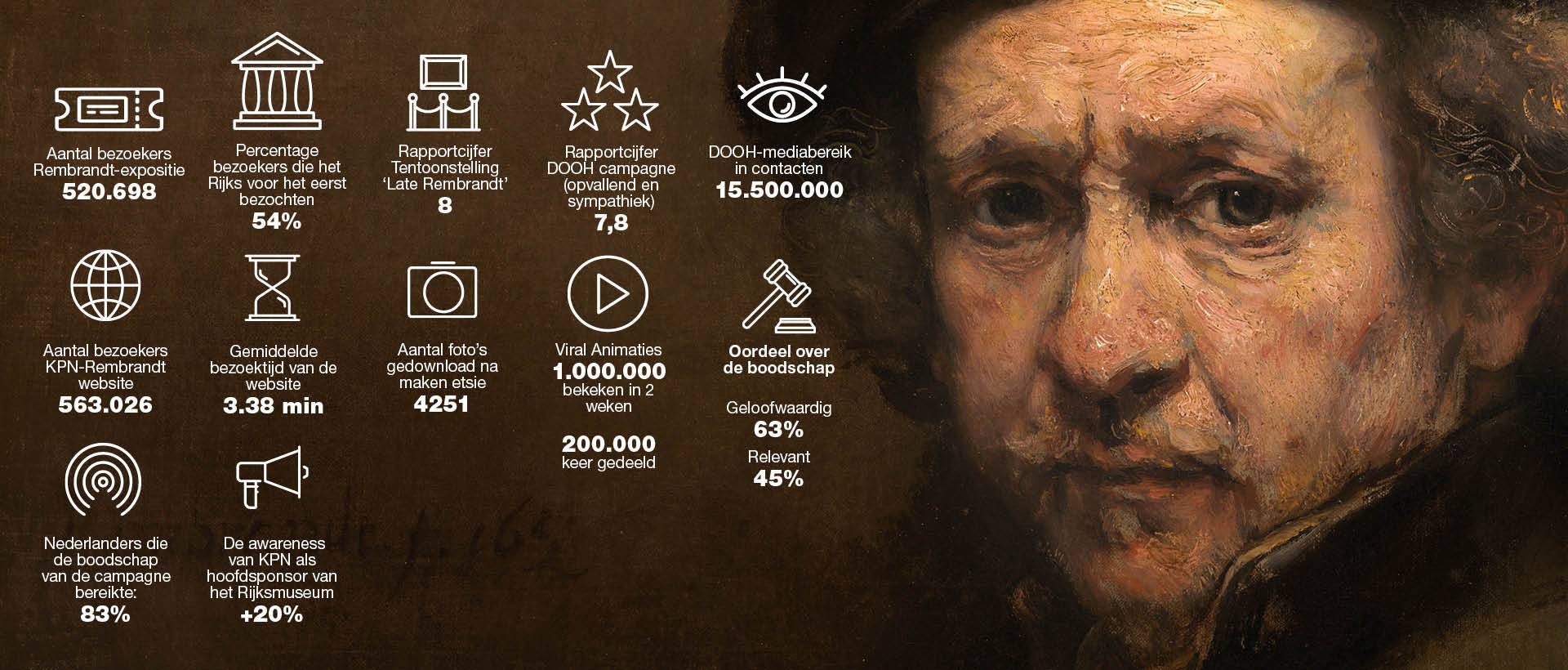
'A campaign becomes even stronger when it's location-based, meaning it connects with the architecture of its surroundings: figuratively, but sometimes literally too. On the screen, you can refer to objects near the screen. That creates the so-called shock of recognition. Finally, I'd like to mention how interactive a screen is. Swiping, touchscreens, gesture-based gaming, you name it. These increase viewers' engagement with the screen and make them stick around longer, especially if there's something to win. And yes, we kept all of these things in mind throughout the Rembrandt campaign.' Although no direct causal link can be established between the individual conventions and attention value, the Rembrandt figures speak volumes in this respect. 'The public gave the shelter executions an average score of 7.8 out of 10 for noticeability and likeability. The campaign also achieved an out-of-home media reach of 15.5 million contacts,' says Van Wilsem. 'And the animations went viral. In two weeks, they were viewed 1 million times in 163 countries and shared 200,000 times on social media. Making an #Etsie also caught on: 4,251 photos were collected on the website.'

Results: What the figures say about the objective
Of course, a case isn't a success without good results from hard measurements. So what were the key research findings?
KPN and the Rijksmuseum also achieved excellent results with the campaign. The campaign's creative, integrated media approach and the accompanying activation led to 563,026 visits to the website, with an average visit time of 3 minutes and 38 seconds! Awareness of KPN as the museum's main sponsor rose by no less than 20 percent. The campaign's core message actually reached 83% of the Dutch population; 63% found it 'credible' and 45% 'relevant'. A positive effect was also measurable among KPN customers. Customers who attended the Rijksmuseum's exclusive evening opening stayed customers for longer. In fact, the number of customers leaving fell by 33%.
At the Rijksmuseum itself, it was a complete madhouse throughout the exhibition, with 520,698 visitors. Yet despite the crowds, Late Rembrandt received an impressive rating of 8 out of 10. A striking finding from the visitor analysis was that 54% were visiting the Rijksmuseum for the first time, including a particularly large number of young people. These figures show that the objective shared by the Rijksmuseum and KPN, drawing attention to one of the greatest artists our country has produced, was more than achieved.
Postscript
Although famous, and often penniless, Rembrandt was certainly not uncontroversial in his day. Clients regularly returned a work because they thought it wasn't 'finished' yet. He also experimented freely with line and light, especially in his self-portraits. He scratched into the paint with the back of his brush and applied thick dabs of paint to the canvas, creating an almost 3D effect. It's hard to draw a direct analogy between Rembrandt and DOOH, but his drive for innovation, risky at times, is something DOOH in general could learn from. 'Practice what you know, and it will help to make clear what now you do not know,' a pup


Vergelijkbare Artikelen

asdfasdfasdf
Lorem ipsum dolor sit amet, consectetur adipiscing elit. Suspendisse varius enim in eros elementum tristique. Duis cursus, mi quis viverra ornare, eros dolor interdum nulla, ut commodo diam libero vitae erat. Aenean faucibus nibh et justo cursus id rutrum lorem imperdiet. Nunc ut sem vitae risus tristique posuere.
Case bekijken


